Modal Verbs
On safari in Kruger National Park, South Africa
Open on your phone
Scan the QR code to open this page directly.
Warm-up 1 · Who lives here? ⏱️ 5 min
Look at the picture. These five animals are famous all over the world – safari tourists call them “the Big Five”.
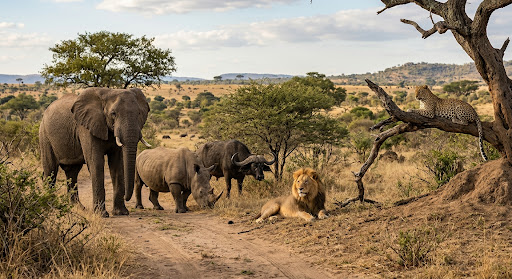
💬 Talk to your partner:
- Which animals can you see? Name all five in English.
- Describe the picture: Where are the animals? What are they doing?
- Which animal would you most like to see on a safari? Why?
- Which animal do you think is the most dangerous? Why?
Useful phrases: In the foreground / background I can see … · On the left / right there is … · In the tree … · I would love to see … because …
✅ Check: the Big Five
🐘 elephant · 🦏 rhino (rhinoceros) · 🐃 buffalo · 🦁 lion · 🐆 leopard
❓ Big question: Where in Africa can you see all five of them in the wild? Find out in Warm-up 2! ➡️
Warm-up 2 · Kruger in numbers ⏱️ 7 min
The answer: in Kruger National Park in South Africa – one of the biggest national parks in Africa. How much do you know about it? Guess! After each answer you get a fun fact.
📊 Kruger at a glance
🦏 Rhinos in Kruger
−78 % – mainly because of poaching (illegal hunting).
🐘 Elephants in Kruger
Protection works – but so many elephants also need a lot of space and food.
💬 Talk about it
- Which number surprised you most? Why?
- Why are rhinos in danger? What can a national park do to protect them?
- Millions of animals, thousands of visitors … What rules do you think visitors have to follow? Write down three rules with your partner.
Sources: SANParks – Vital Information · SANParks – elephant numbers · Africa Geographic (SANParks annual report 2022/23) · Wikipedia
➡️ Now let’s go into the park! At the gate you will see some signs with rules – were your three rules right?
Start: At the gate – the signs ⏱️ 5 min
Imagine you are on a school trip in South Africa. Your bus drives through the gate of Kruger National Park – and these are the first signs you see:
💬 Talk about it
- Compare: Which of your three rules from Warm-up 2 are on the signs?
- What do the signs mean? Say it in your own words.
- Why do you think there are such strict rules in the park?
- Which rule is the most important one? Why?
Task 1 · What do the signs say?
Match every sign with the right sentence. Look at the blue words in the sentences: must, mustn’t, may, needn’t, might … – these are modal verbs.
Task 2 · What does the modal verb express?
Drag every sentence into the right box. Is it about ability, permission, obligation, prohibition, no necessity, advice or possibility?
Modal verbs – the rules
🧩 What are modal verbs?
Modal verbs are helping verbs (auxiliaries). They are used with the infinitive of a full verb – without to:
You must stay in your car. · Leopards can climb trees.
📏 The same form for everybody
No -s for he/she/it, no do/does/did in questions and negatives:
❌ He cans swim. · ❌ Do I should …? · ❌ He can to swim.
✅ He can swim. · ✅ Should I bring a hat?
💬 Alone only in short answers
A modal verb can only stand alone in a short answer:
“Can you see the rhino?” – “Yes, I can.” / “No, I can’t.”
📋 Meanings and substitute forms
Modal verbs can’t form all tenses. For some of them we use substitute forms (Ersatzformen):
| Meaning | Present | Past | Future |
|---|---|---|---|
| 💪 ability | can / am, is, are able to | could / was, were able to | will be able to |
| ✅ permission | can / may / am, is, are allowed to | was, were allowed to | will be allowed to |
| ❗ obligation | must / have to, has to | had to | will have to |
| ⛔ prohibition | mustn’t / am, is, are not allowed to | wasn’t, weren’t allowed to | won’t be allowed to |
| 🆗 no necessity | needn’t / don’t, doesn’t have to | didn’t have to | won’t have to |
| 💡 advice | should / shouldn’t | – | |
| 🤔 possibility | might / may / could | – | |
| 🙂 polite offer / wish | would (Would you like …?) | – | |
⏪ could in the past
could is the past form of can. We use it mainly
- with verbs of perception: We could hear the lions. (see, hear, smell, feel)
- in negative sentences: I couldn’t sleep.
- in questions: Could you see the rhino?
For one special success in the past use was/were able to: After three hours we were able to find the lions.
⚠️ mustn’t ≠ needn’t
mustn’t = something is forbidden (nicht dürfen) → am/is/are not allowed to
needn’t = something is not necessary (nicht müssen) → don’t/doesn’t have to
You mustn’t feed the animals. (It’s forbidden!)
You needn’t book a table. (It isn’t necessary.)
🇩🇪 Trap: „Du musst nicht“ = You needn’t / don’t have to – not “mustn’t”!
🔎 How to recognise it
Ask yourself:
Is it dangerous / forbidden / against the rules? → mustn’t
Is it free, optional, not needed – but OK if you do it? → needn’t
Signal words: forbidden, not allowed, dangerous ↔ not necessary, optional, free, there is already …
Task 3 · mustn’t or needn’t?
Forbidden or just not necessary? Choose the right modal verb.
Task 4 · Ranger Sipho’s welcome talk
Fill in the right modal verb. The German words help you: Pflicht, Verbot, Erlaubnis …
Task 5 · Substitute forms: past and future
Rewrite the sentence in the past or the future. Use the right substitute form. Stuck? Click 💡 Hint.
Task 6 · Tricky cases: could, was able to and short answers
Choose the right answer.